SecuTex ED

Turn endpoint risk into a trackable governance list.

SecuTex ED is a threat-intelligence-driven endpoint risk governance platform that combines asset inventory, compliance assessment, and threat analysis to support both one-time assessments and ongoing governance.

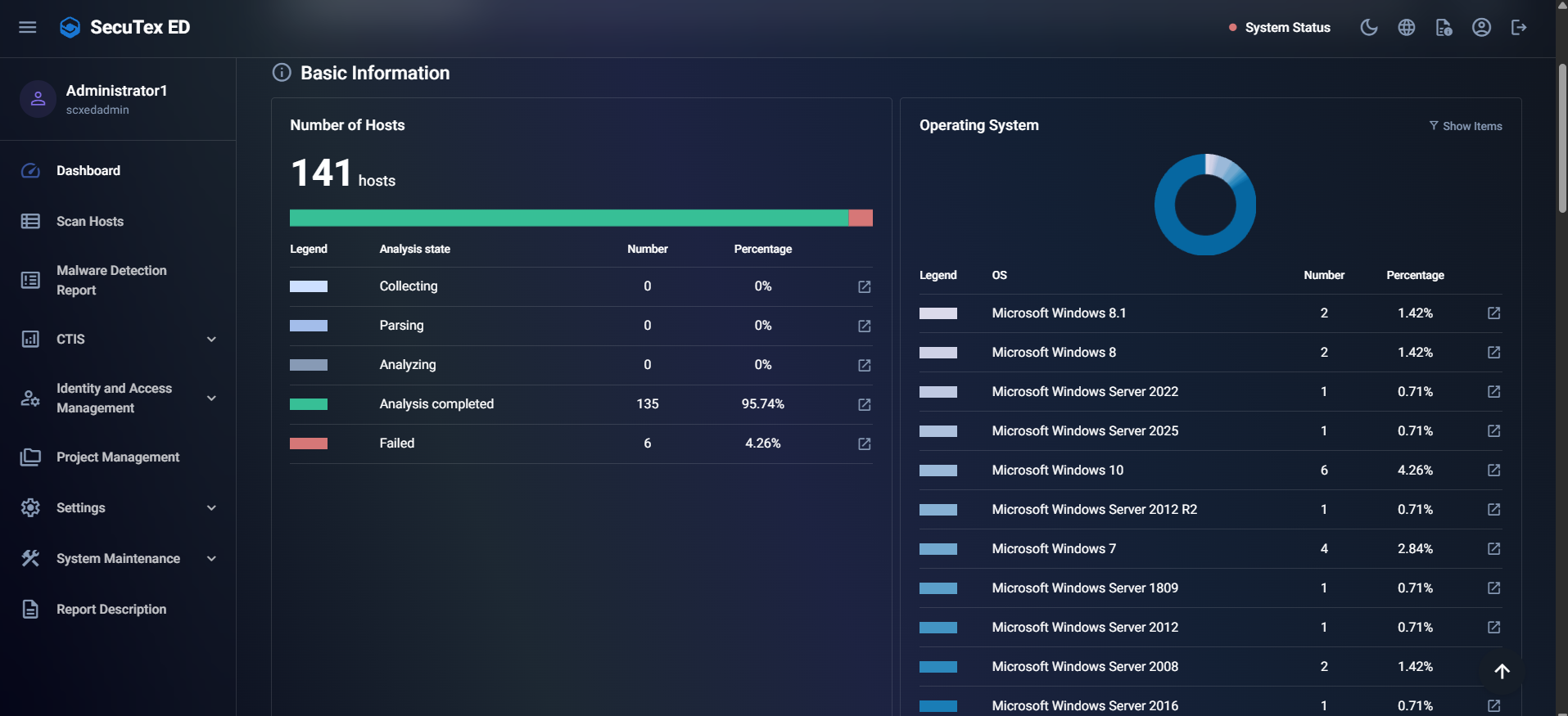
SecuTex ED dashboard
ED dashboards help teams review assessment projects, host status, and risk distribution.

Endpoint Risk Gaps

Four governance blind spots without endpoint assessment and tracking.

When endpoint posture, compliance settings, and threat indicators are scattered across tools or manual records, audits, health checks, and investigations take longer and prioritization becomes harder.

Endpoint status is fragmented

Without centralized OS, IP/MAC, software, antivirus, and update status, administrators cannot see the true distribution of endpoint risk.

Compliance gaps require manual checks

Manual Taiwan government GCB, financial-sector FCB, or custom baseline checks are time-consuming and can miss non-compliant items and remediation priorities.

Suspicious event scope is hard to define

When alerts or intelligence arrive, teams need a fast way to inspect suspicious files, processes, startup items, and IoC hits.

High-sensitivity host changes are hard to track

Without continuous tracking, configuration drift and compliance regression may only surface during audits or incidents.

Editions

Choose an ED edition by assessment mission and management cycle.

On-Demand Scan fits audits, health checks, and post-incident screening. Persistent Agent fits hosts that require long-term tracking of configuration, compliance, and endpoint status.

On-Demand Scan

On-Demand Scan

For annual health checks, pre-audit inventory, post-incident screening, and one-time large-scale endpoint assessments. The executable can be removed after assessment according to the project process, making it suitable for scenarios that do not require long-term management.

Persistent Agent

Persistent Agent

For core servers, high-sensitivity office hosts, and environments that need long-term configuration tracking. The Agent continuously reports endpoint status, helping administrators understand compliance and risk changes.

Core Capabilities

Build a trackable endpoint governance workflow from inventory to threat screening.

SecuTex ED consolidates endpoint posture, compliance status, and threat indicators so teams can act faster during audits, health checks, and initial incident triage.

Inventory

Asset and endpoint posture inventory

Collect endpoint basics, update posture, and assessment results to give administrators a complete asset view and risk distribution.

Compliance

Configuration compliance assessment

Check endpoint security settings against baselines and turn non-compliant items into trackable improvement direction for audits and governance.

Threat Screening

Endpoint threat screening

Screen suspicious files, processes, and IoC clues to help teams quickly define which endpoints need priority handling.

Stories

ED in real endpoint governance

Turn endpoint risk from manual follow-up into collectible, sortable, exportable evidence.

Scenario 01

Annual audit and compliance inventory

Before audits or internal inspections, scan endpoints at scale, compare results against Taiwan government GCB, financial-sector FCB, and custom baselines, and produce compliance evidence and improvement plans.

Scenario 02

Daily endpoint health inventory

Help IT and infrastructure teams understand Windows updates, antivirus posture, software versions, and security settings to identify endpoints that need priority action.

Scenario 03

Rapid suspicious event triage

When intelligence, alerts, or intrusion indicators appear, scan selected endpoints or sites for suspicious files, processes, connections, and IoC hits.

Scenario 04

Multi-unit security governance

Headquarters or security management teams can consolidate endpoint assessment results across departments, branches, or subsidiaries from a single console.

Deployment

Confirm deployment conditions, then choose the right assessment mode.

ED can be introduced for project-based assessment or long-term endpoint management. Clarifying scope, delivery conditions, and result handling before the PoC helps determine whether On-Demand Scan, Persistent Agent, or a phased approach fits best.

Scope

Confirm the management scope

Define the departments, host types, and endpoint scale to keep the PoC focused on real governance goals.

Delivery

Choose the delivery approach

Use existing endpoint management capabilities and network constraints to decide whether one-time assessment, long-term Agent management, or phased adoption fits best.

Outcome

Plan result handling

Confirm how assessment results will be collected, consolidated, and tracked so PoC output can feed audits, remediation, or incident response.

PoC Planning

Need to understand endpoint risk before an audit?

Share endpoint scale, delivery method, and compliance requirements. We can help evaluate ED On-Demand Scan or Persistent Agent adoption.

Book an ED PoC